Notes from being employee number two
I joined Propane as employee number two. I was also the first designer, which in a company that small means that every visual and every interaction decision is, in some way, yours. This is a set of notes about that role. They describe what the job has looked like from the inside, and what I would tell another designer thinking about a role like it. They will not fit every company.
The problem came first
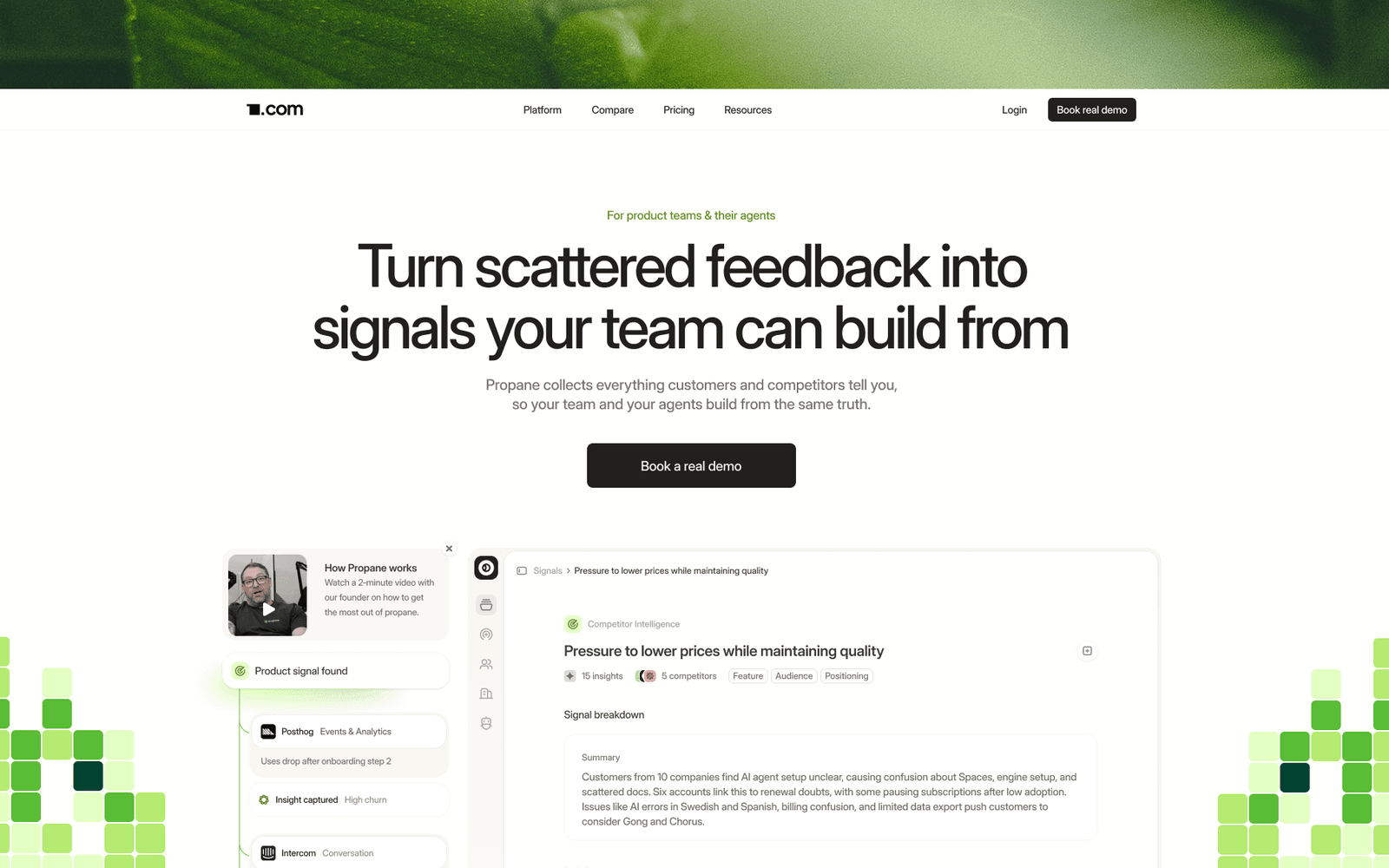
Propane works on a problem every product team knows. Teams have plenty of feedback from customers. It is just spread across every tool they use: call notes, support tickets, sales notes, chat threads and documents. The product pulls it into one place so a team can decide what to build.
Anton Osika from Lovable backed Propane as an angel, along with Morten Wulff.Silicon CanalsSource 1Danish startup Propane raises funding to build AI-native Customer Intelligence OSThe 2025 pre-seed round, which names Anton Osika (Lovable) and Morten E. Wulff among the angel investors.siliconcanals.com When people with that kind of experience back a company this early, they are backing the team and the problem more than any finished product. That is a useful reminder for a first designer. In the beginning, there is no product to protect yet, only a problem to understand well.
I mention this because the problem shaped the job. A founding designer is not hired to make a product pretty. They are hired to help a very small team turn a clear problem into something people can use, as quickly as possible. The design work is real, but it is in service of a question: does this help a team decide what to build?
Scope has no edges
At a large company, a designer has a scope. At a company this small, scope is whatever needs doing this week. In my case that has meant the product, but also the brand, the marketing and the website. Those are mine too.
That sounds like a lot, and it is. It also has an advantage. When one person designs the website and the product, the promise and the experience are made by the same hands. I have written that a company should feel the same in a sales call as in the product. At this stage, keeping them consistent needs no process, because the same person is working in different files.
The cost is focus. There are always three or four important things competing for the same day. My advice is to choose between them on purpose, and in writing, because if you leave the choice open, the most urgent message decides for you.
Brand on day one
Owning the brand in a company this young is a different job from owning it in an established one. There is no brand book to follow and no history to respect. There is also very little time, because the website, the deck and the product all need something now.
My approach is to make the smallest set of decisions that lets everyone move, and to make them carefully. A name and a mark that can grow. One typeface, maybe two. A small set of colours with one clear accent. A tone of voice described in three or four sentences. That is enough to make a website, a deck and a product feel like one company.
Everything else can wait until the company knows more about itself. A young company changes its mind often, and a large brand system made too early becomes something to work around instead of something to work with.
Sketches become product fast
Two of the main parts of Propane, Spaces and Canvas, started as my sketches. In a company this size, the distance between a sketch and something real is short. There is no long chain of handovers and approvals between an idea and the product.
This is exciting, and it is a responsibility. A sketch I made quickly can become something customers use every day. That makes the first version of an idea more important, not less. It is worth sketching two or three different directions before choosing one, because there may not be a second chance to change the structure.
Building it myself
I built Spaces and Canvas in Cursor, an AI code editor. This is one of the biggest changes in my work in the last few years. I have written a separate, practical essay about it, so here I will only say what it changed about the role.
When a designer can build, the conversation with engineers changes. I do not hand over pictures of what I want. I hand over something that works, at least roughly, and we talk about what it should become. Engineers spend less time guessing and more time on the parts that are hard: data, performance, reliability.
It also changes what I notice. When you build a screen yourself, you see the states nobody draws: the loading, the empty list, the error, the very long name. You cannot skip them, because the code shows you every one of them.
Small decisions are made together
Not every decision is a big sketch. Many of the important ones are small and come up in conversation. Rasmus and I worked out how document status should work together, for example. That means the states a document can be in, and how a team moves it from one state to the next. It sounds like a detail. In a product about deciding what to build, the status of a document is close to the centre of everything.
I like this kind of work. Two people, one problem, a whiteboard or a shared file, and an hour. No presentation, no approval, just a decision both people understand and can defend.
How to know it is working
In a big company, a designer gets feedback through reviews, metrics and a manager. In a very small one, those structures do not exist yet. You have to build your own signals.
The ones I trust most are simple. Do customers describe the product in the same words we use? When the team argues, do they point at the strategy or at personal taste? Does a new feature fit into the product without a long explanation? When the answer to these is yes, the design is doing its job, even if no dashboard says so.
What I would tell another designer
If you are thinking about a role like this, here is what I have found matters.
- Pick the problem, not the title. You will spend most of your time inside the problem. If it does not interest you, the title "founding designer" will not help on a hard week.
- Learn to build. Not to replace engineers, but to shorten the distance between an idea and a test. With today's tools, it is more possible than ever.
- Own the words. In a young company, nobody else will write the button labels, the empty states and the homepage headline with the same care. Words are design.
- Write your choices down. Small teams move fast and forget why. A short note on why something was designed a certain way saves a long argument three months later.
- Expect to do sales and hiring. I usually end up in board meetings, go-to-market plans and hiring conversations as well. If you want a role where you only design, this is not it.
Working next to a founder
The first designer works closer to the founder than almost anyone. That relationship shapes the product more than any process does, so it is worth being careful about it.
A few things help. Disagree early and in private, with something concrete to look at, rather than late and in front of the team. Separate the decisions that are the founder's from the ones that are yours, and say out loud which is which. The founder owns the strategy. You own how it looks and feels in the product. Most arguments get easier once that line is clear.
Also, bring options, not only opinions. A founder under pressure can choose between two sketches in a minute. An abstract debate about direction can take a week, and it usually ends with the founder choosing anyway, with less information.
The part that is hard to explain
There is one more thing, and it is harder to put in a list. Being early means you are building the culture of design in the company, whether you plan to or not. How reviews happen, how much quality matters, how decisions get written down: all of this starts with the first designer's habits.
That is a reason to take the role seriously, and also a reason to enjoy it. Very few jobs let you decide how design will work in a company before anyone else has an opinion about it.
Did you enjoy this article?