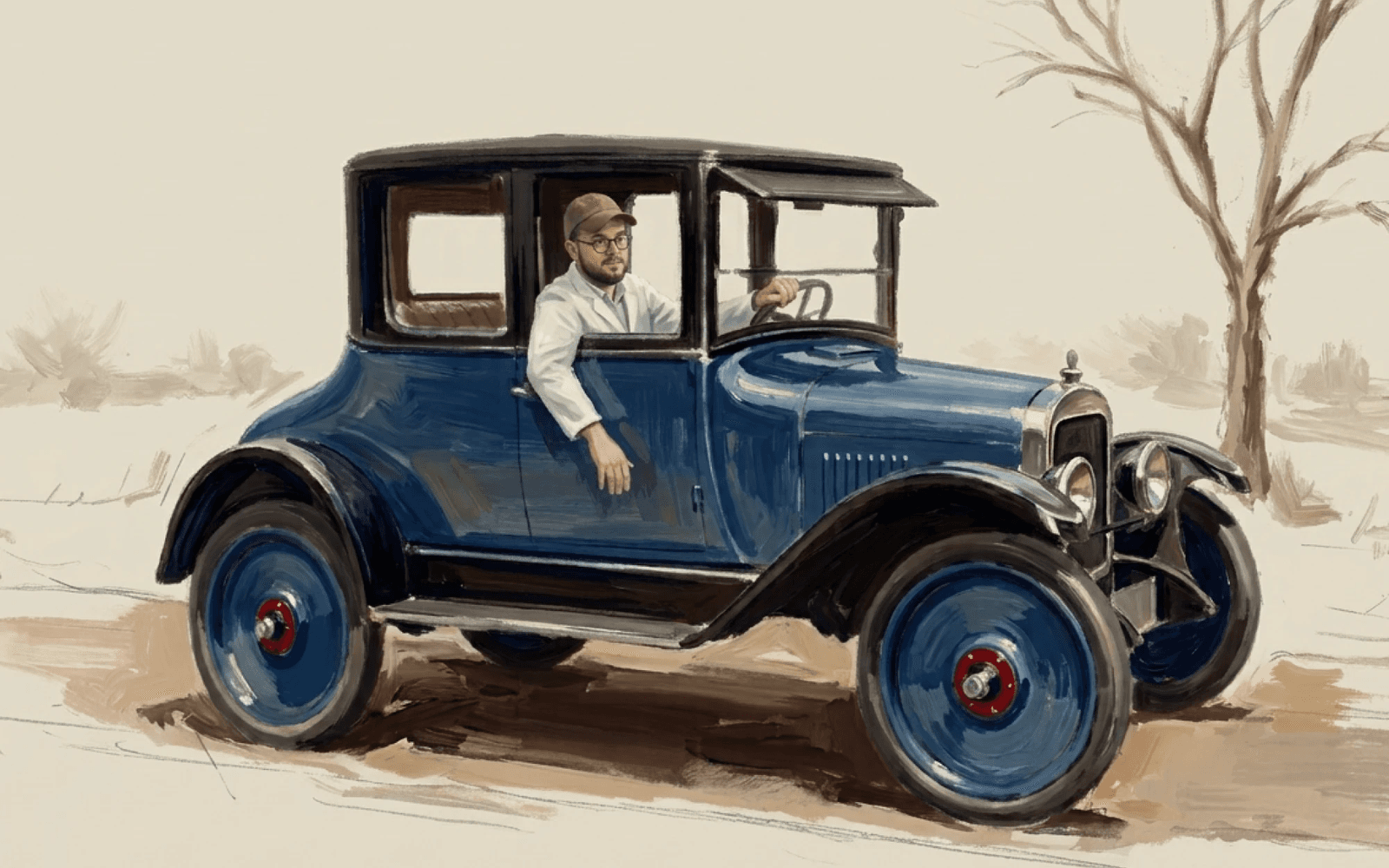
Any colour, so long as it's a chat box
Henry Ford wrote that a customer could have a car painted any colour they wanted, "so long as it is black."People like to quote that line because it sounds so stubborn. There was a practical reason behind it, though. Black paint dried the fastest, and Ford's whole idea was speed: more cars, built faster and cheaper, for more people.For years it worked. Most people simply wanted a car, and they cared much more about being able to afford one than about its colour. In 1921 Ford held 55.7% of the US car market, and General Motors held 12.7%.Then most of the people who wanted a car had one.GM gave people a reason to chooseAlfred Sloan, who ran GM, saw this before Ford did. Once most people had a car, the next buyer was no longer asking if they could get one. They were asking which one to get.Brand 5 min read 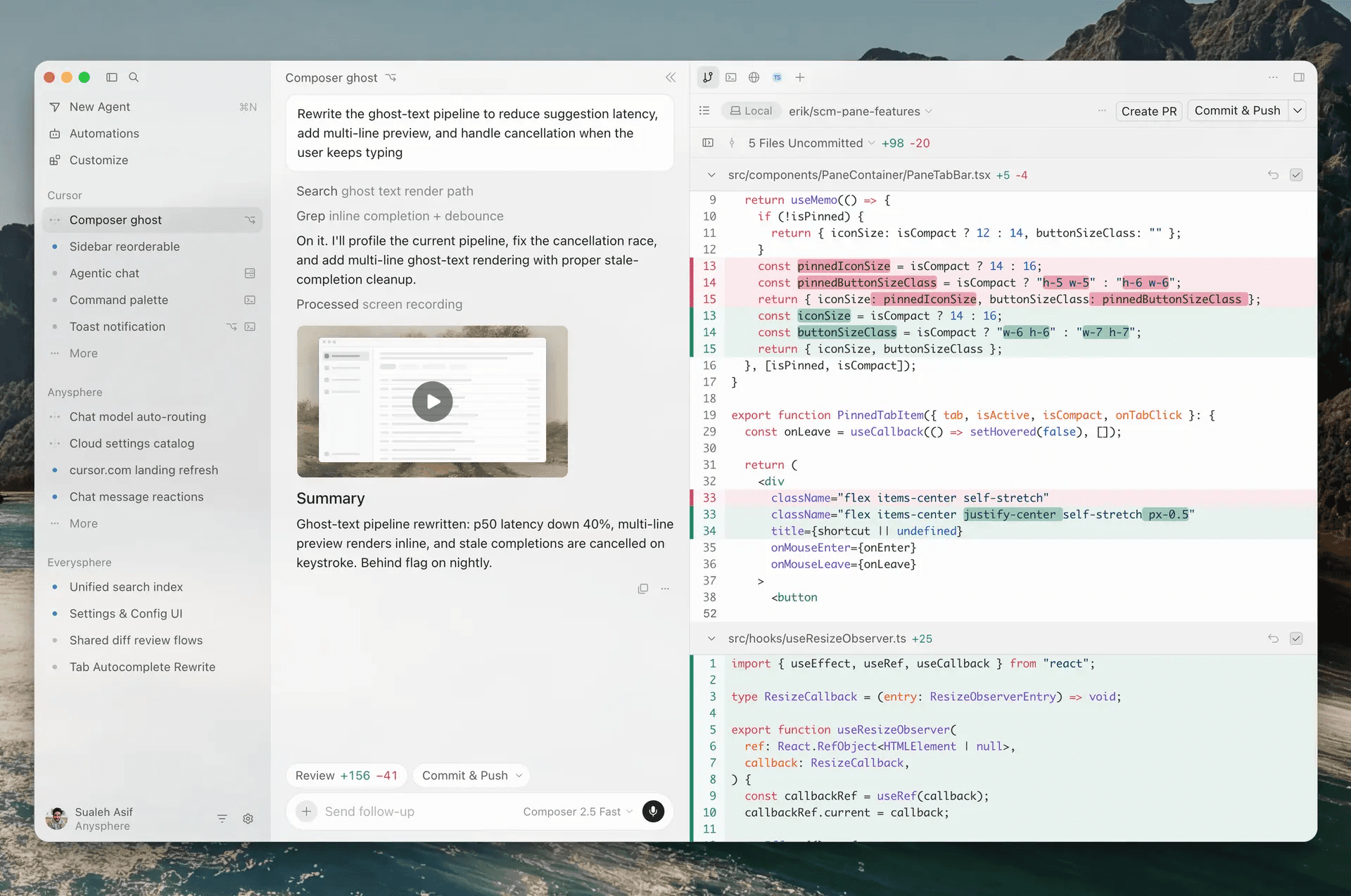
What building product in Cursor taught me as a designer
Two of the main parts of Propane, Spaces and Canvas, started as my sketches. Then I built them in Cursor, an AI code editor. A few years ago, a designer building core product features would have been unusual. Now it is becoming a normal part of the job, at least in small companies.This is a practical essay. It is for designers who are curious about building with AI tools and are not sure where to start, or what to expect. I will also be honest about the limits, because they are real, and ignoring them is how designers lose the trust of their engineers.What changes when a designer can buildIt is faster, but the bigger change is the kind of conversation you can have.When a designer hands over a picture, the engineer has to guess. How does it behave on a small screen? What happens when the list is empty? What does it do while it loads? A good designer draws some of these states. Nobody draws all of them.Craft 9 min read 
Notes from being employee number two
I joined Propane as employee number two. I was also the first designer, which in a company that small means that every visual and every interaction decision is, in some way, yours. This is a set of notes about that role. They describe what the job has looked like from the inside, and what I would tell another designer thinking about a role like it. They will not fit every company.The problem came firstPropane works on a problem every product team knows. Teams have plenty of feedback from customers. It is just spread across every tool they use: call notes, support tickets, sales notes, chat threads and documents. The product pulls it into one place so a team can decide what to build.Anton Osika from Lovable backed Propane as an angel, along with Morten Wulff. When people with that kind of experience back a company this early, they are backing the team and the problem more than any finished product. That is a useful reminder for a first designer. In the beginning, there is no product to protect yet, only a problem to understand well.Startups 7 min read Four ways to talk about your product's future
Nick Foster's Could Should Might Don't came out in 2025. Foster was head of design at Google X, and before that he worked at Sony, Nokia and Dyson. The book is about how we think about the future, and it does not try to predict anything. It names four habits instead, and it argues that most of us lean on one or two and ignore the rest.The book is written about technology and society. While reading it, I kept thinking about a much smaller room, the product planning meeting.The four habitsFoster's four words are easy to remember.Could is the excited future. Anything is possible, and the question is how big it can get. · Should is the future someone has decided on. It is confident, opinionated and often a bit stubborn. · Might is the future as scenarios. Several things could happen, and we try to prepare for more than one. · Don't is the future we want to avoid. It looks for what could go wrong and what we should not build.Strategy 5 min read Good work software is easy to put down
When I design software that people sit in all day, like the planning tool at Mover, I try to make two things true. It should be pleasant to use, and it should be easy to put down.The first one is common sense. The second one goes against a lot of what the industry has learned in the last fifteen years.Consumer apps are often measured on time spent. Every extra minute is a win, so the design pulls you back in: one more notification, one more item in the feed, one more red badge. Some of those habits have moved into work software, because the same people design both and the same numbers look good in a board deck.For a work tool, more time is usually a bad sign. A planner who spends two hours on a task that should take twenty minutes is not engaged. They are stuck. The goal of their day is to get the trucks out and go home. The best tool helps them do that and then gets out of the way.Design 2 min read A design system is a brand decision
When a startup decides it needs a design system, the conversation is usually about efficiency. Engineers are tired of building the same button five times. Designers are tired of fixing spacing in every review. Someone suggests a component library, and the project begins.Those are good reasons, and a system does save time. But I think the more important thing a design system does happens before the first component. It decides what the company looks and feels like in the place customers spend the most time. That is a brand decision, and it deserves to be treated as one.Building it while using itAt Light, I designed the first website and the design system under it while the company was making its first promise to a client. We had committed to take one client through a real invoice review, on a live site, with a system we were still building. There was no time to design the system first and the product later. Every component was made for a real screen that a real customer was about to use.Brand 4 min read Why a designer belongs in the board meeting
The business around the design interests me, so I usually end up in board meetings, go-to-market plans and hiring as well. People are sometimes surprised by this, because a board meeting is about money, growth and risk.I go because the decisions made in that room become design work a few weeks later, whether a designer was there or not.A board asks the company to grow faster in one market. That turns into a new onboarding flow for a new kind of customer. The board worries about churn. That turns into a project to rethink the first thirty days of the product. An investor says the pricing is confusing. That is a design problem with a spreadsheet attached.If the designer was not in the room, they get these problems second-hand, in a short message, with most of the reasoning removed. They then design for the summary, and the summary is usually missing the part that mattered.Startups 2 min read The one-page test for a product strategy
Here is a test I use on any strategy document, including my own. Print it, or imagine you did. Then try to make it fit on one page without making the font smaller.Most documents fail the first time. That is fine. The interesting part is what you have to remove to make it fit.Some things go easily. Background about the market that everyone already knows. A long list of company values. Three versions of the same goal in different words. You can delete these and nothing changes.Other things are harder to cut, and those are the useful ones. Usually there are two customer groups, and the document serves both, so you cannot remove either section. Or there are two ways to win, speed and price, and the document keeps both because people in the room care about each one.Strategy 2 min read 
Taste is the part you can't prompt
A year or two ago, making a decent-looking screen took a designer an afternoon. Today an AI tool can make ten of them in a minute. Most of them look fine. Some look very good.This has made many designers nervous, and I understand why. If the making is cheap, what is left of the job?My answer is that the making was never the whole job. It was the visible part. The other part, deciding what to make and knowing when it is right, is now more important than before, because there is so much more to choose from.From maker to curatorAndy Budd wrote about this in 2024. His argument is that designers are moving from makers to curators. When tools can produce many options quickly, the designer's value moves towards selecting, refining and judging them. He also warns that taste and craft could be weakened, if everyone can produce "good enough" work without them.Craft 4 min read How to redesign software people use all day
On the day goods move, a planner opens Mover, and the whole day is right there: every route on the map and every run on the timeline. IKEA and Nemlig run their deliveries on it, which is how Ingka Investments, IKEA's investment arm, got involved. When I joined Mover as Head of Design & UX, Mover had already been live for a few years.That made the work a bit like renovating a house with people still living in it. You cannot close the kitchen for a month. Somebody needs to cook dinner tonight. Over my time there I redesigned the routes view and the map, then the order details and the driver app, and built up a team of product and UX designers. This essay is about what a redesign like that asks of a designer, and how it is different from designing something new.Design 7 min read A brand is a promise the product has to keep
People sometimes ask me where the brand of a software company lives. The easy answer is the logo, the colours and the website. Those things matter. They are also the smallest part of it.For a product that people use every day, the brand is mostly made inside the product. A customer sees the website once or twice. They see the product for hours every week. Whatever the website promised, the product either keeps that promise or it does not, and the customer decides what the brand means from that.So I think of brand work in two parts. The first part sets an expectation: this is who we are and what it will feel like to work with us. The second part keeps it. The second part is much bigger, and most of it is ordinary product design.Some examples of what keeping the promise looks like:Brand 2 min read Sit next to your first users
At Light, I sat next to the first clients while they used what we had built. It is the most useful research I know for a young product, and it is also the simplest.You sit next to someone while they do real work with your product: their actual job, with their actual data, on a normal day. You do not need a script or a lab, and the task should be theirs rather than one you invented.Then you keep quiet. That is the hard part. You will want to explain, help and defend. Every time you do, you lose the thing you came for, which is seeing what happens when you are not there to explain.Watch for three things:Where they slow down. A pause is a question the interface did not answer. · What they read twice. Usually a label, a number or a message that was clear to the team and not to them. · What they never look at. Often a feature the team is proud of.Design 2 min read Positioning comes before the logo
A founder sends me a message. They have a name, a deck and some money, and they want a logo by next month. It is a reasonable request. A logo is something you can see, and seeing it makes the company feel real.I usually answer with a question about positioning instead. That can feel slow. In practice it makes the logo faster, because the hard part of a logo is the decision behind it.What positioning meansApril Dunford's book Obviously Awesome is the most practical guide I know on this. She describes positioning as the context you put a product in, so that the right customers understand why it matters. Her method starts with a simple question: if your product did not exist, what would customers use instead?That answer is your real competition. Often it is a spreadsheet, an email thread, an agency or a person who does the job by hand, rather than another startup. Once you know the alternative, you can say what is different about your product, why that difference matters, and who cares most about it.Strategy 4 min read Make the promise, then build it
Light did not have a product yet, but it had made a promise. We would take one client through a real invoice review, on a live site, using a design system we were still building.I was on the Light founding team with Philip and Jonathan Sanders, and I designed the first site and the system under it. We kept the promise. Later, Atomico, Balderton and Seedcamp backed the company. I want to write about the promise itself. I think it was one of the most useful design decisions we made, even though it was a business decision.A promise is a strategy you can feelStartups talk a lot about focus. A real date with a real client is focus you can feel in your body. Once the promise was made, many questions answered themselves. The features that mattered were the ones this client needed for this review. The screens that had to be perfect were the ones they would see. Everything else could wait.Startups 4 min read The sales call is part of the product
One idea has stayed with me for most of my career. A company should feel like the same company in a sales call as it does in the product.It sounds obvious. In practice, it is rare. Most B2B companies are three companies at once. There is the company in the sales call, which is warm, flexible and promises a lot. There is the company on the website, which is polished and a little vague. And there is the company in the product, which is honest, because software cannot pretend.Customers meet all three. They notice the gaps, even when they could not tell you what they noticed.Why the gaps appearNobody plans this. It happens because different people own different moments. Sales owns the call. Marketing owns the website. Product and engineering own the product. Each team does good work for its own goals, with its own words and its own deadlines.Brand 4 min read Strategy is a few choices you can say out loud
Ask five people in a young company what the strategy is. You will often get five different answers. One person talks about the next funding round. Another one talks about a feature. A third one shows you a slide with words like "customer first" and "best in class". All of them are trying to help, and none of them has answered the question.For about 18 years I have worked with founders and CEOs on strategy, brand and product. The best strategies I have seen were short. You could say them out loud in a meeting, and people would nod, because they already knew. The weak ones were long documents that nobody opened twice.A strategy is a set of choicesThe clearest definition I know comes from Roger Martin, who wrote Playing to Win with A.G. Lafley. They describe strategy as a set of connected choices. Where will we play? How will we win there? What do we need to be good at to win? Each answer limits the next one.Strategy 5 min read